
BEST BRINE
FAQs
Learn more about salt brine, anti-icing, de-icing, proper salt applications, road treatments, additive an enhancers from our experts at Best Brine.
1. What is Salt Brine?
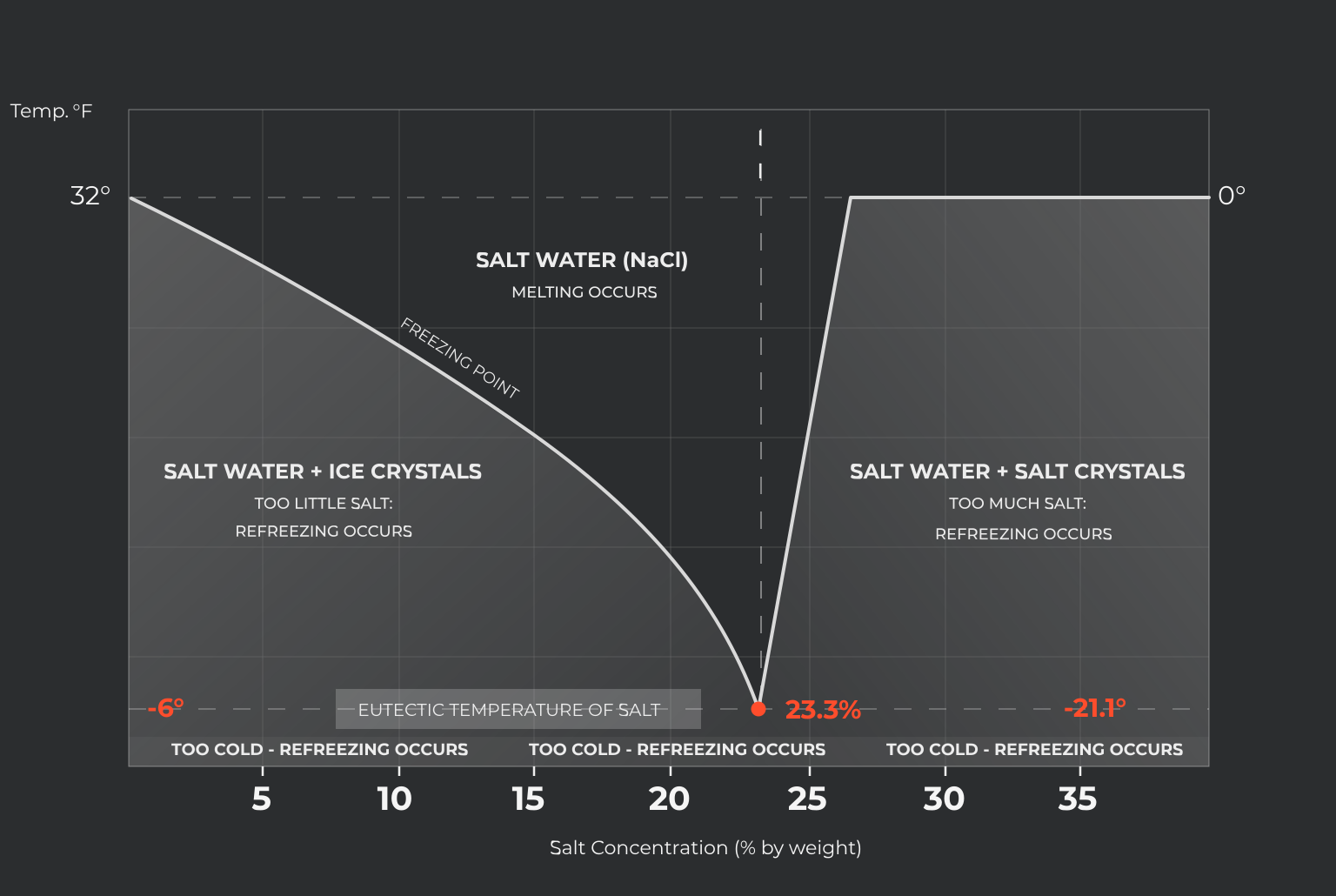
Salt brine is a proven liquid solution used to combat snow and ice on pavement surfaces. It’s created by mixing granular sodium chloride and water in a controlled process to achieve the optimal salinity of 23.3% — a ratio of 2.28 lbs of salt per gallon of water (76.7%). Once the desired concentration is achieved, the brine is pumped into storage tanks, ready for pre-, inter-, or post-storm applications.
2. What is Salinity and a Eutectic Point?
Salinity is the concentration of dissolved sodium chloride expressed as a percentage by weight in water. The Best Brine™ is manufactured at 23.3% salinity — this precise concentration can be stored indefinitely without loss of effectiveness. The eutectic point of brine is its maximum saturation at the lowest possible freezing temperature, allowing it to reach -6°F.
A common misconception is that eutectic temperature and effective temperature are the same—they’re not. The eutectic temperature is the lowest possible temperature at which a solution remains liquid. Effective temperature (or practical working temperature) refers to the temperature range where the product performs effectively in real-world winter conditions, which is often higher than its eutectic temperature.
Salt Brine: Phase Diagram
3. Why should I buy brine that’s already in solution?
No Capital Investment Required
Eliminate the need for a brine maker, storage tanks, pumps, plumbing, and dedicated facility space.
Ready When You Need It
Skip the time required to source salt, make brine, and verify salinity. Pick up or receive professionally manufactured product that’s ready for immediate use.
Flexible Access and Delivery
Take advantage of our 24/7 self-service truck fill station or convenient delivery directly to your facility. Our fast-fill system can be adjusted from 50 to 300 GPM, providing efficient loading for operations of any size.
Reduced Labor and Maintenance
Eliminate the labor and expense associated with producing brine in-house. No staff time, equipment operation, or ongoing repair costs required.
Consistent Quality You Can Trust
Professionally manufactured and tested to ensure precise salinity and reliable winter performance. Our Henderson BrineXtreme® Advantage™ measures salinity using density rather than conductivity, providing accurate and consistent results. Every batch is verified with a digital Misco refractometer to ensure it meets our quality standards.
4. What is Anti-Icing?
Anti-icing (Pre-treatment) is a proactive approach applied 24 to 48 hours ahead of snow or ice events. Pre-treating with liquid brine prior to snowfall prevents snow and ice from bonding to the pavement and could prevent mild accumulation. You want a broad, even coverage to seep into all pores of the surface; this allows for a cleaner mechanical scrape and reduces the amount of de-icing material needed after the storm.
5. What is De-Icing?
De-icing (Post-treatment) is a reactive approach performed after snow or ice events. Salt brine is applied onto the remaining snow or ice after mechanical clearing. You want to apply the liquid using stream or pencil nozzles at high pressure so it can penetrate the surface. Using liquids as a post-treatment allows you to achieve bare pavement faster while using less chloride, minimizing environmental impact. With no leftover undissolved salt on the pavement surface, you reduce tracking, lower janitorial costs, provide clients with a cleaner property, and minimize property damage both inside and out.
6. How much should I apply?
Anti-icing (Pre-treatment) ranges from 40 to 50 GPA. De-icing (Post-treatment) ranges from 80-100 GPA, but if you have heavy snowpack or buildup, 120 GPA may be needed. If high wind is present or forecasted, wait to spray, as blowing snow will stick to the pavement versus blowing across. GPA = Gallons Per Acre
7. Should I use an additive or enhancer?
This can be subjective, but in our operation, we use an additive 99% of the time. We recommend using an additive when temperatures drop below 18°F.
Additives are blended with 23.3% salt brine on a percentage basis (e.g., 95–5, 90–10, 85–15, 80–20). Additives contain calcium, magnesium, and/or organic by-product enhancers (OBPEs) that lower the freezing point; polymers that aid in traction; corrosion inhibitors that can be up to 90% less corrosive than granular rock salt; and tackifiers that seep into the surface and hold up against traffic and precipitation.
We offer a variety of additives and blend options to fit your needs.
8. How can I start using liquids? Or, what is the best way to learn?
The easiest way to introduce liquids into your operation is to start with sidewalks. They’re one of the first things your clients notice when they walk into a building—and with liquids, there’s no crunchy salt left behind to be tracked indoors. You’ll improve your level of service while increasing efficiency and profit margins.
If you run a Snowrator, you’re already set up—it comes equipped with a 20-gallon tank ready for liquid application.
Start small with sidewalks, key accounts, or targeted sections of roadways, then expand your liquid program as you fine-tune your process. Every storm is different, so take notes after each event and continue making adjustments.
9. What are the benefits of switching to liquids?
Switching to liquids boasts many benefits over granular.
Able To Be Proactive
Liquid brine can be applied 24 to 48 hours before a storm as a pre-treatment to prevent snow and ice from bonding to pavement. This makes mechanical removal much easier and faster.
Consistent and Even Coverage
Brine is sprayed uniformly across surfaces, providing consistent coverage, whereas traditional rock salt tends to bounce and scatter. The liquid seeps into the pores of the surface and stays there.
Skip the Phase Change
You’ll no longer have to wait for granular salt to dissolve—it begins working immediately upon contact. In contrast, granular salt must first come into contact with snow or ice before becoming effective. Liquid solutions can work 3–4× faster than granular products, helping you achieve bare pavement faster.
Environmental Benefits & Cost Savings
Using brine can reduce total salt usage by up to 35% during pre-treatment and up to 70% post-treatment, significantly lowering material costs. With less chloride runoff, it also helps protect soil and waterways.
Did you know? ONE teaspoon of salt pollutes FIVE gallons of water permanently.
Improved Service Quality
Brine delivers bare pavement faster and remains effective at lower temperatures than rock salt. This enhances road and property safety while improving your company’s reputation for reliable, high-quality service.
Safer, Cleaner Properties
Say goodbye to “crunchy salt” tracked indoors or piled at entrances. Brine provides a cleaner, more professional appearance and, with the use of an additive, is up to 90% less corrosive than traditional granular salt—helping protect your clients’ infrastructure while saving on maintenance and janitorial costs.
Did you know? A single ton of granular rock salt can cause between $800 and $3,000 in permanent damage to infrastructure — including pavement, steel, turf, and landscaping.
10. What challenges are there switching to liquids?
Switching to liquids can come with a learning curve — it’s a new approach, and at first, it can feel overwhelming. Every storm is different, which means application rates and blends may need to be adjusted based on conditions.
There is also an initial capital investment in liquid spraying equipment. During events such as freezing rain, ice, or rapidly dropping temperatures, achieving the desired results may require higher product usage or enhanced additive blends.
The good news is that you don’t have to figure it out alone. Whether you’re new to liquids or looking to improve an existing program, we’re here to help. From equipment selection and application rates to additives and best practices, we’re committed to helping you build a successful liquid de-icing program.